
史上最大IPO,SpaceX上市开盘大涨29%,马斯克没去现场长安街知事
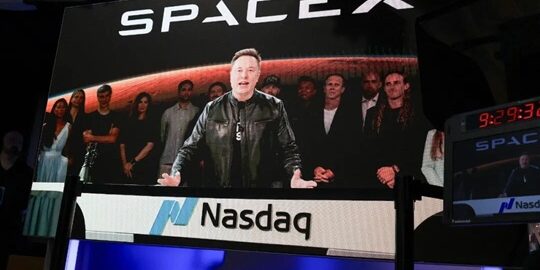
长安街知事(微信ID:Capitalnews)注意到,马斯克本人并没有前往纽约纳斯达克交易所现场,而是在得克萨斯州的SpaceX总部发表了视频讲话,随后进行了远程敲钟。
当地时间6月12日,美国纽约纳斯达克交易所,SpaceX首席执行官埃隆·马斯克通过屏幕远程从得克萨斯州星际基地的SpaceX总部发表讲话。图源:视觉中国
募资750亿美元、上市市值高达1.77万亿美元(约合11.97万亿元人民币),超级IPO开启了一场史无前例的财富盛宴。有人称其为马斯克“星辰大海”的启航,也有人质疑其万亿估值全靠“梦想”支撑,SpaceX这场昂贵的“追梦”,有待资本市场的进一步检验。
SpaceX由马斯克于2002年创立,业务包括航天发射、卫星互联网和人工智能三大领域。此次上市,SpaceX将发行价锁定在135美元/股。按发行5.556亿股计算,其募资规模约750亿美元——这将大幅超越全球最大石油生产公司沙特阿美2019年上市时294亿美元,成为资本市场史上规模最大的IPO。
如果承销商全额行使超额配售权,再额外发行8333万股,那么SpaceX最终募资规模还将进一步扩大至862.5亿美元。
135美元发行价对应的公司市值达1.77万亿美元。照此计算,SpaceX上市时就已超过马斯克旗下的电动汽车企业特斯拉,成为美国市值第七大上市公司。一些乐观的声音认为,SpaceX市值将冲上2万亿美元,仅次于英伟达、苹果、Alphabet(谷歌母公司)、微软和亚马逊。
如华尔街知名投行奥本海默给予该股“跑赢大盘”的评级,以及190美元的目标价。这意味着,相较SpaceX发行价仍有超40%的上涨空间,估值也将高达2.5万亿美元。
质疑的也不少。曾成功做空安然的著名空头吉姆·查诺斯公开表示,SpaceX的万亿估值仅靠“梦想”支撑,缺乏基本面支撑。财务数据显示,SpaceX2025年全年公司营业收入为186.7亿美元,亏损49.4亿美元。三大业务板块中,仅卫星互联网“星链”是唯一实现盈利的。自2002年成立至今,SpaceX累计亏损规模约413亿美元。
2025年5月27日,SpaceX新一代重型运载火箭“星舰”在得克萨斯州实施第九次试飞。新华社发
随着Space X登上资本市场舞台,一场前所未有的财富盛宴同步开启。
那些押注公司早期的风险投资机构,将因此获得高达数百亿美元的超级回报。如风险投资公司Founders Fund在2008年就参与投资,近二十年来累计向SpaceX投入约6亿美元,持股比例约3%。如今按发行价计算,其持仓市值就已超500亿美元。
SpaceX长期推行员工持股和股权激励机制。根据股权交易平台的估算,此次上市有望在SpaceX员工中创造约4400名新晋百万富翁。其中,约400名现任及前员工持股价值将达到或超过1亿美元。
作为公司最大股东,创始人马斯克的个人财富也会因本次IPO而再度暴增。有测算显示,以135美元发行价计算,马斯克净资产将达9880亿美元,距全球首位万亿富豪仅一步之遥——股价只需再涨2.2%至138美元。如今,这一步在开盘已轻松实现。
SpaceX’s stock price surged 29% at the opening of its largest IPO in history; Elon Musk was not present. (Chang’an Street Observer)
Chang’an Street Observer (WeChat ID: Capitalnews) noted that Musk himself did not go to the Nasdaq Stock Exchange in New York, but delivered a video speech from SpaceX headquarters in Texas, and then rang the bell remotely.
On June 12, local time, at the Nasdaq Stock Exchange in New York, SpaceX CEO Elon Musk delivered a speech remotely from SpaceX headquarters at Starfield in Texas via a screen. (Image source: Visual China)
With $75 billion raised and a market capitalization of $1.77 trillion (approximately RMB 11.97 trillion), SpaceX’s mega-IPO has unleashed an unprecedented wealth feast. Some call it the start of Musk’s “dream of the stars,” while others question whether its trillion-dollar valuation is solely supported by “dreams.” SpaceX’s expensive “dream-chasing” remains to be seen and will be further tested by the capital market.
Founded by Elon Musk in 2002, SpaceX’s business encompasses three main areas: space launch, satellite internet, and artificial intelligence. For its IPO, SpaceX set its offering price at $135 per share. Based on the issuance of 555.6 million shares, it raised approximately $75 billion—significantly exceeding the fundraising of Saudi Aramco, the world’s largest oil producer.It went public in 2019 for $29.4 billion, becoming the largest IPO in the history of the capital market.
If the underwriters fully exercise their over-allotment option and issue an additional 83.33 million shares, SpaceX’s final fundraising will further expand to $86.25 billion.
The IPO price of $135 corresponded to a market capitalization of $1.77 trillion. Based on this calculation, SpaceX surpassed Elon Musk’s electric car company Tesla at the time of its IPO, becoming the seventh-largest publicly traded company in the United States by market capitalization. Some optimists believe that SpaceX’s market capitalization will reach $2 trillion, second only to Nvidia, Apple, and Alphabet.(Google’s parent company), Microsoft, and Amazon.
For example, renowned Wall Street investment bank Oppenheimer gave the stock an “outperform” rating and a target price of $190. This means that there is still more than 40% upside potential compared to SpaceX’s IPO price, and its valuation could reach as high as $2.5 trillion.
There has been considerable skepticism. Jim Chanos, the renowned short seller who successfully shorted Enron, publicly stated that SpaceX’s trillion-dollar valuation is supported only by a “dream” and lacks fundamental support. Financial data shows that SpaceX’s revenue for the entire year of 2025 was $18.67 billion, with a loss of $4.94 billion. Of its three main business segments, only its satellite internet service, Starlink, is profitable. Since its founding in 2002, SpaceX has accumulated losses of approximately $41.3 billion.
On May 27, 2025, SpaceX’s next-generation heavy-lift launch vehicle, Starship, conducted its ninth test flight in Texas. (Xinhua/Photo)
With SpaceX stepping onto the capital market stage, an unprecedented wealth feast has begun.
Venture capital firms that bet on early-stage companies will reap enormous returns of up to tens of billions of dollars. For example, venture capital firm Founders Fund…Having invested since 2008, the company has invested approximately $600 million in SpaceX over the past two decades, holding about 3% of the shares. Based on the IPO price, its holdings are now worth over $50 billion.
SpaceX has long implemented employee stock ownership and equity incentive mechanisms. According to estimates from equity trading platforms, this IPO is expected to create approximately 4,400 new millionaires among SpaceX employees. Of these, approximately 400 current and former employees will have stock holdings valued at or exceeding $100 million.
As the company’s largest shareholder, founder Elon Musk’s personal wealth will also surge again due to this IPO. Calculations show that, based on the offering price of $135, Musk’s net worth will reach $988 billion, just one step away from becoming the world’s first trillionaire—the stock price only needs to rise another 2.2% to $138. Now, that step has been easily achieved at the opening bell.