
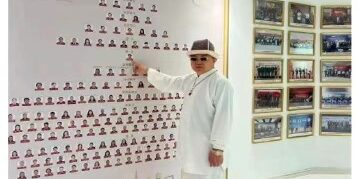
陈建⻰ (著名企业家 ):中阿投资路上的红杉树
—- 独⽊成林
⼆⼗三年前的2003年, 英⽂版《海尔之路》在美国出版。 由于当年管理教⽗GE 董
事⻓⻙尔奇在华尔街⽇报推荐了这本书,该书引起了极⼤关注。笔者也受国务院侨办的邀请
回到家乡成都,安排采访了⼀系列四川的⻰头企业,包括⻓虹电器和新希望集团。四川最
⼤报业集团- 华⻄都市报明星记者团队许佳和她的同事们⼀路随⾏,我写⼈物专题报道,他
们发媒体新闻。我们在刘永好先⽣新希望集团⼀住就是7天。刘先⽣当时刚刚从澳洲引进
了特别的奶⽜,开发成后来成为中国著名品牌“华⻄⽜奶”, 让将近1亿⼈⼝的四川平原和
⼤⼩街道,每天清晨送奶的⼩⻋叮叮当当从⼤⼤⼩⼩的社区穿进穿出,成为四川⼈的起床号。
记得当时采访刘先⽣时, 他说了⼀句让我永不能忘怀的⼀句话: “哪怕眼前全是绝望,也
不能放弃希望。”
那天,我们谈到他的第⼀桶⾦是怎样打来的。谁都知道是卖鹧鸪蛋。但第⼀窝鸡蛋⼏
乎“全军覆没”。 “那天晚上⽉⿊⻛⾼还下着⾬, 我骑着⼀辆⽼旧的⾃⾏⻋,⻋的两边挂着
两框鸡蛋,这是我们四兄弟全部的积蓄买来的。我⼼急赶夜路,在⽥埂上滑倒了,掉进了沟
⾥。鸡蛋⼏乎全部打碎。看着⼀地的蛋壳,我坐在泥地上,禁不住放声⼤哭…那是我⽣
命中最⿊暗的时刻。”
新希望乳业 给家⼈最好的⽜奶
我和身边的记者,眼泪也哗哗地淌了下来。同时我们也明⽩ ⼀个道理:那就是像刘
永好先⽣这样的⼈,倒不了。他们的钱是⼀分⼀分赚来的。不是资本市场的⼀夜暴富。他
们知道什么叫⾟苦。和初⼼不变。
“我们⺠营企业家, 就像家乡的榕树, ⻓在⼭边地头。哪怕有⼀点⼟,⼀点⽔, 我
们的根须就会穿⽯⽽过,独⽊成林。”
时间往前跑着。⼀跑23年就过去了。
我来到迪拜。⻅到了陈建⻰先⽣。⼜⻅到了⼀颗独⽊成林的⼤树。那不是我家乡的
⼤榕树。 那是⼀棵⻓在中东沙漠的红杉. ⽤阿拉伯语来说, 那是⼀棵⻓着华盖, 能独⽊
成林的 bigredwood.
企业出海 企业家背靠的是祖国- 这个不倒的万⾥⻓城
问:为什么取这个名字- 个⼈标识?还是企业标识?
在解密这个答案之前,先讲讲我第⼀次听到这个字的发⾳ AkMarr的感觉,毕竟我在美国
⽣活了41年⼜是学⽂学的, ⽣命的DNA⼀定融合着好莱坞⼤⽚的⾊彩。 这个字, 是不
是——Aquaman?
脑海⾥不是⼀个⼈,⽽是⼀整套叙事。X-Man,Spiderman,Aquaman。他们来⾃不同的世界,
拥有不同的能⼒,都是超⼈, SuperMan。 他们做的可是同⼀件事: 在改变世界的同时,
也重写⾃⼰的命运。
况且,当我们⼀想到中亚的贸易之路,脑海⾥总会⾃动跳回到⼀个时代——
唐朝。
不是书本⾥的唐朝, ⽽是有声⾳有画⾯的唐朝。有骆驼的铃声,⼀下⼀下,在⻛⾥回
响。
那是⼀条真正连接世界的路。从中东,到中亚,再到⻓安。他们带来⾹料、宝⽯、故事,也
带来不同的语⾔、不同的信仰。⽽中国,把丝绸、瓷器、制度与⽂明,⼀点⼀点送出去。这
条路,从来不只是贸易。它是交换。也是碰撞,当然,有骆驼的铃声,也有强盗的⻢蹄。
在唐朝最辉煌的时候,世界,并不在远⽅。它就在⻓安的酒馆⾥。胡⼈的身影,他们的乐器,
他们的歌声, ⼀个胡⼈的⼥⼦,在酒馆⾥唱着异乡的旋律。⼀个乐师,拨动着来⾃远⽅的
琴弦。直到今天,在敦煌的壁画上,这些栩栩如⽣的画⾯依然清晰可⻅, 那是世界最了不
起的中国古代艺术集成。那不是历史,⽽是被时间保存下来的朝代的相遇,不同国度的⼈
们的相遇。
2026年。中国“⻢年”—- ⼀个看似普通的时间节点。但就在这个时刻,我⾛进了⼀个名
字——阿克曼(Akmar )。⾛进了陈建⻰先⽣和他创建的 Akmar 商贸⾦融世界。
没有骆驼。但有港⼝。有法规。有资本。有系统。还有⼀套陈总30 多年经商管理,在
⽇本企业 中东皇储和中国制造业中,获得第⼀⼿资料和案例写成的 Z管理模式。那是⼀
条充满荆棘的路, 那也是⼀条成功的路。和他的企业家前辈刘永好先⽣⼀样, 曾经也是
满眼凄凉,在绝望的井底,也绝不放弃头顶上的那⼀⽚光亮。
希望。
唐朝的丝绸之路,靠的是脚步与勇⽓。今天的这条路,靠的是结构、资⾦与信任。但本
质,从未改变。
仍然是——
⼈,跨越边界,去寻找远⽅的彼此。在某⼀个瞬间,是重叠的。
华⼈报团的⼒量和⾏业的⽀持
问:陈建⻰是谁?
陈建⻰先⽣, 他不是⼀开始就在中东的。他的起点,在中国南⽅。在那个改⾰开放邓
⼩平南巡讲话后还带着潮湿⽓味、却已经开始向世界张开的城市——深圳。
30多年前,⼀个从北⽅⾛出来的中国⻘年,
和千千万万个同样优秀的年轻⼈⼀样,带着⾼等学府的学历- 陈建⻰是带着北京⼤学的
光环, 带着⼀点点不确定,和极⼤的梦想- 南下。来到这个曾经的渔村正在变成世界都市
的地⽅。在那⾥,他买下了两套当时⾮常便宜的房⼦。不是投资,⽽是⼀种——“我要留下
来”的决定。
2008年⾦融⻛暴, 扫荡了他的⼀切积累。带着卖了两套房⼦的钱,来到迪拜。开始
进⼊⼀个完全不同的世界和体系。
他和当地酋⻓国的家族合作,把中国的制造能⼒,接⼊中东的政策、资源与资⾦。那不是简
单的贸易。那是⼀种新的连接⽅式,但是是从贸易开始的。他和和合伙⼈做了⼀件很具体的
事情:
⽤电器,去打开⼀条路。⽤LED,去点亮⼀座城市。当⼀座城市被点亮的时候。 他看
到的,不只是灯。是系统。是能源。是供应链。
是背后那整套看不⻅的结构和供应链⾦融。
这已经不是在“另起炉灶求⽣做⽣意”,这是在重新搭建⼀条路。⼀条从中国,通往阿
拉伯世界新的丝绸之路。在异国他乡打下了第⼀桶⾦给第⼆桶⾦, 但他的野⼼,没有停在
这⾥。如果你已经在沙漠⾥点亮了⼀座城市,你不会只满⾜于灯光。
你会开始想——能不能让这些灯光,照亮⼼中那棵树?⼀棵在沙漠⾥,
也能成为“系统”的树。像⼀棵红杉。不是⼀棵,⽽是⼀整⽚。
于是,公司开始扩张。不是线性的,
⽽是像⽣命体⼀样。像树⼲,向外延伸。像根系,深⼊不同的⼟地。像⽑细⾎管,进⼊
世界的细部。
与当地皇室和政府的合作
今天,他拥有 40多家公司,遍布36个国家。贸易,仍然在做。但那已经不只是贸易。
那是⼀个系统。⼀个跨越五⼤洲的、
持续流动的结构。
当我们来到陈总的办公室时, 这条路⾛到了世界的另⼀个地⽅——世界的⾦融之都
华尔街。世界的⾦融中⼼。在那⾥,他和合伙⼈建⽴了⾃⼰的⾦融平台。
从深圳,到中东,再到纽约。这不是简单的“发展、扩张”。这是⼀条完整的路径:从制造、
到贸易,到系统,再到资本。
我站在这条路上,忽然想到:唐朝的丝绸之路,靠的是⼈⾛过去。⽽今天的这条路,
是被⼈,⼀点⼀点“建出来”的。
事业的起伏
2008年来到迪拜之后,陈总的事业并不是⼀开始就站在⾼点,⽽是从最基础的贸易做起。
最早,是电⼦产品贸易。那是⼀种以“数量”为单位的⽣意——⼏⼗万、⼏百万美⾦,⼀
单⼀单地做。然后,他进⼊了第⼆个台阶:⼤宗贸易。⼀旦进⼊这个领域,起点就完全不同
了。他说,做油,⼀单就是1.5亿美⾦起。
“这就是两个阶梯。”
他说得很平静,但你能感觉到,那不是⾏业的区别,是世界的切换。
再往上,是第三个层级——地产开发与基础设施建设。到了这⾥,数字已经不再是“单
笔交易”,⽽是“项⽬体量”。⼗亿、百亿。
⽽真正让他区分过去的⾃⼰和现在的⾃⼰,“⾃⼰是否还要亲⾃参与”的—— 是⾦融。
他说,现在如果⼀个项⽬低于10亿美⾦,基本不需要他亲⾃决策。只有到10亿美⾦以上,
他才会“亲⾃进去看”。⽐如多哈⼤桥。 ⽐如沙迦AI科技新城。
这句话说得很轻,但其实是⼀种权⼒边界的表达。—— 不是他能不能做,⽽是“什么样
的规模,才值得他出现”。
从⼏⼗万,到⼏百万,到上亿,再到百亿,再到⼗亿起点的⾦融项⽬——
这不是简单的增⻓,⽽是⼀种阶梯式的跃迁。
于是我顺着这个逻辑,问了陈总⼀个问题:
“这种不断上升的量级,和你书⾥讲的Z管理模式,有关系吗?”
他点了点头。他说,其实Z管理的核⼼,不是管理本身,⽽是不同规模企业,必须匹配
不同的管理模型。⽐如,⼀个⼗⼈以下的公司,是⼀种逻辑。⼀百⼈,是另⼀种逻辑。
上千⼈,就已经是“规模企业”,管理⽅式完全不同。他说了⼀句很形象的话:⼀开始创业,
其实就是“夫妻店”。太太在前⾯接单,先⽣在后⾯炒菜。那个时候,不需要管理。
因为所有的计算,都在⼀个⼈的脑⼦⾥就可以完成。
但现在?
迪拜电影节 (4.10-4.14) 世界人民的电影节 /Dubai Film Festival (April 10-14) /好莱坞家庭电影奖 (Family Film Awards) .
《故乡的目光》音乐会 4/11/世界著名女高音徐霞
下⼀篇:企业的规模化和贸易链⾦融
来⾃全球的⽀持- ⼀个下午签了两张⼤单..
Chen Jianfeng (renowned entrepreneur): The Redwood Trees on the Road to Sino-Arab Investment
—A Forest of Independent Trees
New York Golden Voice
Twenty-three years ago, in 2003, the English version of *The Haier Road* was published in the United States. Due to
a recommendation from GE CEO Michael Hertz in the *Wall Street Journal*, the book garnered significant attention. I was also invited by the Overseas Chinese Affairs Office of the State Council
to return to my hometown of Chengdu to conduct interviews with a series of leading Sichuan enterprises, including Longhong Electric and New Hope Group.
Xu Jia and her colleagues from the Huaxi Metropolis Daily, Sichuan’s largest newspaper group, accompanied me throughout the trip; I wrote feature articles, and they
published the news. We stayed at Mr. Liu Yonghao’s New Hope Group for seven days. Mr. Liu had just imported
a special milk from Australia, which he developed into the famous Chinese brand “Huaxi Milk.”
Every morning, the clanging of milk trucks crisscrossing the Sichuan plains and streets, serving nearly 100 million people, became the wake-up call for the people of Sichuan.
I remember when I interviewed Mr. Liu, he said something I’ll never forget: “Even if all you see is despair, you
can’t give up hope.”
That day, we talked about how he got his first bucket of gold. Everyone knows it was from selling partridge eggs. But his first clutch of eggs almost
completely failed. “That night, it was raining heavily in the late September. I was riding an old bicycle with
two baskets of eggs hanging on either side—these were bought with all the savings of my four brothers. I was rushing through the night when I slipped on a ridge and fell into a ditch
. Almost all the eggs were broken. Looking at the eggshells scattered on the ground, I sat on the muddy ground and couldn’t help but burst into tears… That was
the darkest moment of my life.”
New Hope Dairy gives the best milk to families
. Tears streamed down my face, as did those of the reporter beside me. At the same time, we understood a truth:
people like Mr. Liu Yonghao will not fall. Their money was earned penny by penny, not overnight riches from the capital market. They
know what hardship is. And their original intentions remain unchanged.
“We private entrepreneurs are like the banyan trees of our hometown, growing tall on the edge of the desert. Even with just a little rain or water, our
roots will penetrate and form a forest.”
Time flies. Twenty-three years have passed in a flash.
I came to Dubai. I met Mr. Chen Jianlong. I saw a giant tree that had formed a forest on its own. It wasn’t the
giant banyan tree of my hometown. It was a redwood growing in the Middle Eastern desert. In Arabic, it’s a tall, canopy-like tree that can
form a forest on its own.
Entrepreneurs going global have their motherland—this unyielding, ancient city—backed by their motherland.
Question: Why this name—personal identity or corporate identity?
Before revealing the answer, let me share my first impression of this word, AkMarr. After all, I
‘ve lived in the US for 41 years and studied literature; my DNA is undoubtedly intertwined with the glamour of Hollywood. This word, isn’t
it—Aquaman?
It’s not just one person in my mind, but an entire narrative. X-Man, Spiderman, Aquaman. They come from different worlds,
possess different abilities, but they are all supermen. They all do the same thing: change the world while
rewriting their own destiny.
Moreover, when we think of the trade routes of Central Asia, our minds automatically jump back to an era—
the Tang Dynasty.
Not the Tang Dynasty in books, but the Tang Dynasty with sound and images. The sound of camel bells echoed through the city
.
It was a road truly connecting the world. From the Middle East to Central Asia, and then to Chang’an. They brought materials, treasures, and stories, as well as
different languages and beliefs. China, in turn, sent out silk, porcelain, institutions, and civilization, bit by bit. This
road was never just trade. It was exchange. It was also collision; of course, there was the sound of camel bells, and also the hooves of bandits.
At the height of the Tang Dynasty’s glory, the world wasn’t far away. It was right there in the taverns of Chang’an. The figures of foreigners, their instruments,
their songs—a foreign woman sang a melody from a foreign land in the tavern. A musician plucked
the strings of a harp from afar. Even today, the lifelike paintings on the Dunhuang murals remain clearly visible, representing one of the world’s most remarkable
collections of ancient Chinese art. It’s not just history, but a meeting of dynasties,
a meeting of people from different countries, preserved by time.
2026. China’s “Year of the Horse”—a seemingly ordinary point in time. But at this moment, I entered a name
—Akmar. I entered Mr. Chen Jianlong and his Akmar Business and Finance World.
There were no camels. But there were ports. There were regulations. There was capital. There were systems. And there was a
Z Management Model, compiled from Mr. Chen’s over 30 years of business management experience, drawing on firsthand data and case studies from Japanese companies, Middle Eastern royal families, and Chinese manufacturing. It was a
thorny path, but also a path to success. Like his predecessor, entrepreneur Liu Yonghao, he too once
faced utter desolation, but even at the bottom of a well of despair, he never gave up
hope .
The Silk Road of the Tang Dynasty relied on footsteps and courage. Today’s road relies on structure, capital, and trust. But the
essence remains unchanged.
It is still—
people crossing borders to find each other in distant lands. At a certain moment, they overlap.
The strength of the Chinese community and the support of the industry…
Q: Who is Chen Jianlong?
Mr. Chen Jianlong, he didn’t start in the Middle East. His starting point was in southern China. In
Shenzhen, a city still damp and bustling after Deng Xiaoping’s Southern Tour speeches, yet already opening up to the world.
Over 30 years ago, a young Chinese man from the north,
like millions of other equally brilliant young people, carrying the prestige of a prestigious university—Chen Jianlong, from Peking University
—along with a touch of uncertainty and a grand dream, headed south. He arrived in a
place that had once been a fishing village but was transforming into a global metropolis. There, he bought two very inexpensive properties at the time. It wasn’t an investment, but a
decision to “stay.”
The 2008 financial crisis wiped out all his savings. With the money from selling the two properties, he went to Dubai, entering
a completely different world and system.
He partnered with local emirate families, connecting China’s manufacturing capabilities with Middle Eastern policies, resources, and capital. It wasn’t a simple…
It was a new form of connection, but it started with trade. He and his partners did something very concrete
:
using electrical appliances to open a road. Using LEDs to light up a city. When a city was lit up
, he saw more than just lights. He saw a system. He saw energy. He saw a supply chain.
He saw the entire invisible structure and supply chain finance behind it.
This was no longer “starting a business from scratch,” it was rebuilding a road. A
new Silk Road from China to the Arab world. He earned his first fortune in a foreign land, but his ambition didn’t stop
there. If you’ve already lit up a city in the desert, you won’t be satisfied with just the lights.
You’ll start thinking—could these lights illuminate the tree in your heart? A tree in the desert,
capable of becoming a “system.” Like a redwood. Not just one tree, but an entire swath.
Thus, the company began to expand. Not linearly,
but like a living organism. Like a tree trunk, extending outwards. Like a root system, penetrating different lands. Like capillaries, entering
the details of the world.
Partnerships with local royalty and governments.
Today, he owns over 40 companies across 36 countries. Trade continues. But it’s no longer just trade.
It’s a system. A
continuously flowing structure spanning five continents.
When we arrived at Mr. Chen’s office, the road led to another place in the world—the world’s financial capital—
Wall Street. The world’s financial center. There, he and his partners built their own financial platform.
From Shenzhen to the Middle East, and then to New York. This isn’t simply about “development and expansion.” It’s a complete path: from manufacturing
to trade, to systems, and then to capital.
Standing on this path, I suddenly thought: the Silk Road of the Tang Dynasty relied on people traveling there. Today’s road, however,
was “built” bit by bit by people.
The ups and downs of his career :
After arriving in Dubai in 2008, Mr. Chen’s career didn’t start at a high level; he began with the most basic trade.
Initially, it was the trade of electrical products. That was a business based on “quantity”—tens of thousands, millions of US dollars,
done one order at a time. Then, he moved to the second level: large-scale trade. Once he entered this field, the starting point was completely different
. He said that in the oil business, a single order started at 150 million US dollars.
“These are just two ladders,”
he said calmly, but you could sense that it wasn’t a difference in industries, but a shift in the world.
Above that is the third level—real estate development and infrastructure construction. At this stage, the numbers are no longer about “single
transactions,” but about “project scale.” Billions, tens of billions.
What truly distinguishes him from his past self and his present self, and what determines whether he still needs to be personally involved, is finance.
He said that now, if a project is less than $1 billion, he basically doesn’t need to make personal decisions. Only when it reaches $1 billion or more
will he “personally go in and take a look.” Like the Doha Bridge. Like the Sharjah AI Technology City.
This statement is made lightly, but it’s actually an expression of the boundaries of power—not whether he can do it, but “what
scale is worth his involvement.”
From tens of thousands to hundreds of millions, to hundreds of millions, to billions, and then to financial projects starting at billions—
this isn’t just simple growth, but a step-by-step leap.
Following this logic, I asked Mr. Chen a question:
“Is this ever-increasing scale related to the Z management model you discussed in your book?”
He nodded. He said that the core of Z management isn’t management itself, but rather that different
management models must be matched to companies of different sizes. For example, a company with fewer than ten people follows one logic. A company with one hundred people follows another. A company with thousands of people
is already a “large-scale enterprise,” and the management style is completely different. He used a very vivid analogy: At the beginning of a business,
it’s essentially a “mom-and-pop shop.” The wife takes orders in the front, and the son cooks in the back. At that time, there’s no need for management.
Because all the calculations can be done in one person’s brain.
But now?


爱之缘 鹊之桥( Global Single Group ) 单身 活动 Single Party 3/28 世界单身联谊会活动世界单身联谊会主办.欢迎参加 .. register www.gsg365.com