
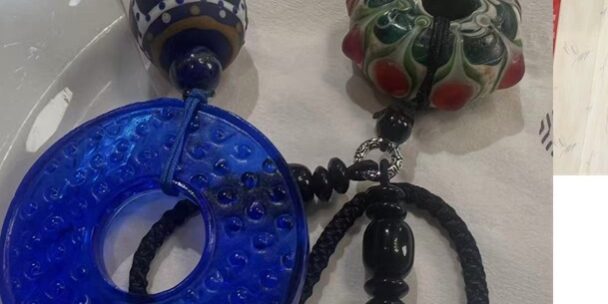
让藏品自己说话:请证明我是假的/
Let the artifacts speak for themselves: Prove I’m a fake—when a two-thousand-year-old dragonfly eye makes a request and challenges to people today.
——当一颗两千年前的蜻蜓眼,向今天的人发出请求和挑战
By Dr. Jeannie Yi
收藏界有一个几乎永远不会缺席的问题。无论是在拍卖会、博物馆、收藏家聚会,还是社交媒体上,只要一件古代艺术品出现,总会有人首先问一句:“这是真的吗?”
每当听到这个问题,我都会想起手中的一颗战汉蜻蜓眼。不是因为它价值多少,也不是因为它有多么罕见,而是因为它让我意识到,我们今天讨论古董时,往往从一开始就问错了问题。真正的问题从来不是“它是真的吗”,而是“我们真的看见它了吗”。
两千多年前,在中国古代某个不知名的作坊里,一位工匠站在熊熊燃烧的窑炉前。那个时代没有电脑,没有显微镜,没有现代化学分析仪,更没有今天意义上的材料科学。然而,他却掌握着一种令今天许多人难以想象的技术。他知道如何让不同颜色的琉璃在高温中融合,知道如何控制火焰的温度和节奏,也知道如何在最微妙的瞬间,让红色、蓝色、绿色、黄色和白色在熔融状态下彼此交织,如同花朵般层层绽放。
于是,一颗蜻蜓眼诞生了。
今天,当我们把它拿在手中时,我们看到的是一件小小的器物。而对于两千年前的工匠来说,那却是一场创造,一次人与火焰、矿物和时间之间的合作。我们看到的是结果,而他们经历的是过程。我们看到的是一颗珠子,而他们创造的是一种奇迹。
这恰恰是今天许多人面对古代艺术品时最大的误区。现代社会习惯用商业逻辑审视一切,于是关于古董的讨论很快就变成了价格、证书、来源和成交纪录。这些当然重要,它们构成了现代收藏体系的一部分,也像藏品进入当代社会后的身份证明。然而,任何真正伟大的文明遗产,其价值从来不只是这些文件和数字能够定义的。
因为一颗战汉蜻蜓眼背后所承载的,并不仅仅是一件艺术品。它凝聚着那个时代的材料学知识、美学观念、工艺技术、贸易交流和文化传播。它是技术,也是艺术;是商品,也是信仰;是工艺品,更是一个文明留下的密码。
遗憾的是,今天很多人更愿意相信标签,而不是相信美;相信文件,而不是相信时间。于是,当他们面对一件跨越两千年的作品时,首先产生的不是敬畏,而是怀疑。仿佛怀疑本身就代表专业,仿佛否定比理解更容易获得权威。
然而市场会造假,文件会遗失,专家会犯错。唯独时间不会。
时间从来不会替任何人说话,但时间会留下证据。能够穿越两千年而依然存在于今天的东西,本身就已经完成了一次最残酷的筛选。它经历过战争,经历过王朝更替,经历过火灾、水患、迁徙与掠夺。无数拥有过它的人已经消失在历史长河之中,而它却依然存在。某种意义上,它比我们任何人都更了解历史。
所以有时候我会想,如果这颗蜻蜓眼真的能够开口说话,它会说什么?
我想,它大概不会急于向任何人证明自己。它不会展示报告,也不会引用专家意见,更不会在网络上与人争辩。它只会平静地看着眼前的人,然后反问一句:
“凭什么说我是假的?”
因为从它的角度来看,它已经经历了两千年的时间考验,而质疑它的人,可能连自己的人生都还没有走完。它见过帝国兴衰,见过文明更替,见过无数人的拥有与失去。最终,它来到今天,来到你的手中。这本身就是一种力量,也是文明最伟大的胜利。
也正因为如此,我越来越认同一种新的收藏观。不是让市场先说话,不是让专家先说话,也不是让各种江湖传闻先说话,而是让藏品自己说话。真正伟大的藏品从来不需要讨好任何人。它只是静静地存在着,然后向每一个站在它面前的人提出几个问题:你是否拥有穿越时间的想象力?你是否能够看见两千年前那团燃烧的火焰?你是否能够理解,一个古代工匠如何在火焰之中创造出今天依然令人惊叹的色彩?
如果看不见,那么它在你眼中不过是一块玻璃。如果能够看见,那么你看到的将不再是一件藏品,而是一段文明,一种智慧,以及一场跨越两千年的对话。
而在这场对话的最后,那颗蜻蜓眼或许只会留下这样一句话:
“我已经生活了两千年。现在,轮到你来证明我不是真的。”/
Let the collection speak for itself: Please prove I’m fake.
—When a dragonfly’s eye from two thousand years ago issues a request and a challenge to people today.
By Dr. Jeannie Yi
There’s one question that almost never fails to resonate in the world of collecting. Whether at auctions, museums, collector gatherings, or on social media, whenever an ancient artwork appears, someone will invariably ask the first question: “Is this real?”
Whenever I hear this question, I think of a Han Dynasty dragonfly eye crystal in my hand. Not because of its value, nor because of its rarity, but because it makes me realize that when we discuss antiques today, we often start by asking the wrong question. The real question is never “Is it real?” but rather “Did we really see it?”
More than two thousand years ago, in an unknown workshop in ancient China, a craftsman stood before a roaring kiln. In that era, there were no computers, no microscopes, no modern chemical analyzers, and certainly no materials science in the modern sense. Yet, he possessed a technology unimaginable to many today. He knew how to fuse different colors of glass at high temperatures, how to control the temperature and rhythm of the flames, and how, in the most delicate moments, to make red, blue, green, yellow, and white intertwine in their molten state, blooming layer upon layer like flowers.
And so, a dragonfly eye was born.
Today, when we hold it in our hands, we see a small object. But for the artisans of two thousand years ago, it was a creation, a collaboration between man and fire, minerals, and time. We see the result, while they experienced the process. We see a bead, while they created a miracle.
This is precisely the biggest misconception many people have when facing ancient art today. Modern society is accustomed to examining everything through a commercial lens, so discussions about antiques quickly turn to price, certificates, provenance, and sales records. These are certainly important; they constitute part of the modern collecting system and act as identification for collectibles in contemporary society. However, the value of any truly great cultural heritage can never be defined solely by these documents and figures.
Because what lies behind a Warring States or Han Dynasty dragonfly eye is more than just a work of art. It embodies the material science knowledge, aesthetic concepts, craftsmanship, trade exchanges, and cultural dissemination of that era. It is technology, and it is art; it is a commodity, and it is faith; it is a craft, and even more so, it is a code left behind by a civilization.
Unfortunately, many people today are more willing to believe labels than beauty; to believe documents than time. Therefore, when faced with a work spanning two millennia, their first reaction is not awe, but skepticism. It’s as if skepticism itself equates to expertise, as if denial is a more readily accepted form of authority than understanding.
However, markets can falsify data, documents can be lost, and experts can make mistakes. Only time remains constant.
Time never speaks for anyone, but it leaves evidence. Anything that has survived two thousand years and still exists today has already undergone the most brutal selection process. It has endured war, dynastic changes, fires, floods, migrations, and plunder. Countless people who once possessed it have vanished into the annals of history, yet it remains. In a sense, it understands history better than any of us.
So sometimes I wonder, if this dragonfly eye could really speak, what would it say?
I imagine it won’t be in a hurry to prove itself to anyone. It won’t present reports, cite expert opinions, or engage in online debates. It will simply look calmly at the person before it and then ask a question in return:
“Why do you say I’m fake?”
From its perspective, it has withstood the test of two thousand years, while those who question it may not even have finished their own lives. It has witnessed the rise and fall of empires, the changing of civilizations, and the gaining and losing of countless people. Ultimately, it has come to this day, into your hands. This in itself is a power, and the greatest victory of civilization.
This is why I increasingly endorse a new perspective on collecting. It’s not about letting the market, experts, or rumors speak for themselves, but about letting the collection speak for itself. Truly great collections never need to please anyone. They simply exist quietly, posing a few questions to everyone who stands before them: Do you possess an imagination that transcends time? Can you see the burning flame of two thousand years ago? Can you understand how an ancient craftsman created colors within those flames that still amaze us today?
If you can’t see it, it’s just a piece of glass to you. If you can see it, then what you see is no longer a collectible, but a civilization, a wisdom, and a dialogue spanning two thousand years.
And at the end of this conversation, that dragonfly eye might only leave behind this one sentence:
“I have lived for two thousand years. Now, it is your turn to prove that I am not real.”


广告. 品牌. 赞助 美国环宇电视传媒联系:7322165001. 9177052606.
专访国际著名古董收藏家、鉴赏家、企业家 叶凌宇(Jeff Ye) 博士 美国环宇电视传媒 www GHYTV.com
相亲大会 (爱之缘 鹊之桥活动) 5/31( Global Single Group Activity ) 注册 www.gsg365.com
广告. 品牌. 赞助 美国环宇电视传媒联系:7322165001. 9177052606
网上直播, 全球同步推出: 届时大家能上网
Two-Thousand-Year-Old Light Still Glows Warmly
— Jeff Collection Special Exhibition at Rockefeller Center, Manhattan
Time: Friday, May 29 | 3:00 PM – 6:00 PM
Presented by Wall Street Podcast 华尔街直播
旅美著名钢琴演奏家和教育家 &莫扎特课室 ( Amadeus Piano Studio) 创办人–许乐道老師
Video link
相亲大会 (爱之缘 鹊之桥活动) 5/31( Global Single Group Activity ) 注册 www.gsg365.com/欢迎广告赞助商
征婚择偶 爱之缘 鹊之桥 活动 Single Party 5/31 ( Global Single Group Activity )
纽约华人社区姻緣平台大放异彩一一"世界单身联誼会"( Global Single Group) 悉心为华裔单身男女喜結良緣牵线搭桥
(本台訊) 生活在大洋彼岸的北美地区华裔男女,因忙于事业,学业,创业,尤其人与人各自奔波谋生,緊張拼搏,造成人与人接触交流机会甚微。从而許多成功男女,优秀异性失去寻找婚姻,交友寻觅,谈婚论嫁,幸福家园之良机。华人第二故乡纽约之"世界单身联谊会",结合纽约乃至全美华人华侨男女婚姻实际状況。从多方位多角度贴近單身男女"求爱寻偶"之需求。定期举办以"愛之緣,鵲之桥"为主題的单身聚会活动。同時,为引导单身男女方便分享交友信息,单身联谊会还提供網絡会员注冊:WWW•gsg365.com網站。微信报名:7323316189 /9177052606,确切方便单身男女交友寻觅之平台。
世界單身联谊会经常开展,集体聚会一对一交友活动,以拓展透明服务平台,让单身高学历,高素质,經濟基础好,白领及行业精英节省时间,抓住机遇,在"相亲聚会"现场,可以选到意中人或佳期可乘留下共同联络信息,为佳緣成功创造良机和条件。
纽约"世界单身联誼会"( Global Single Group) 立足纽约,面向全美乃至世界,为优秀单身男女牽线搭桥,祝天下有緣人終成眷属!
(本台记者 Andrew Li )

著名剪纸艺术家张月英 剪纸艺术 & 服装秀 V1 美国环宇电视传媒www.GHYTV.com
Jeannie Yi (裔锦声博士)专访加州财长马世云(Fiona Ma) the 34th Treasurer of California 好莱坞家庭电影奖 ( The Family Film Awards) /裔锦声博士 好莱坞家庭电影奖代理主席、缅街影视集团总裁&制片人/世界电影学院院长/华尔街重心集团创始人/华尓街人力资源专家/BIBS访问教授/华尔街直播间/https://youtu.be/kllc0IhxsrE
Video link
https://youtu.be/kllc0IhxsrE
好莱坞家庭电影奖/爱情电影
https://youtu.be/JyDLxPd1kzU
Video link
https://youtu.be/STQ2Q0CazPY
Video link
https://youtu.be/zZ_BLtb00Ao
国际魔术大师 世界魔术冠军 奇乐(吴苏雄)老师 为纽约高院法官和律师表演魔术 "神奇大罗丝(神奇大罗丝 魔术-创始人冯修文大师) 魔术表演 美国环宇电视传媒 www.GHYTV.com
郭伯昱教授 ( 世界风水大师)美国环宇电视传媒 www GHYTV.com
5/31 activity. www.gsg365.com.
世界著名华人女性 国际著名教育家荣丽亚 院长 引爆巴菲特大会 BIBS 波士顿国际商学院 震动全球资本与AI格局 波士顿国际商学院(BIBS)美国环宇电视传媒 www GHYTV.com
Video link
https://youtu.be/SYfvjEAXiBQ